- All
- Product Name
- Product Keyword
- Product Model
- Product Summary
- Product Description
- Multi Field Search
Views: 0 Author: Site Editor Publish Time: 2026-04-13 Origin: Site


Compared with cuplock scaffolding, tube & coupler scaffolding, and frame scaffolding, ringlock system shows obvious advantages in overall cost efficiency, safety, assembly speed, and long-term performance:
Connection: Ringlock uses 8-point rosette discs; cuplock only 4-point cups.
Stability: Ringlock has stronger lateral rigidity and better wind resistance, more suitable for high-rise and heavy-duty shoring.
Flexibility: Ringlock supports horizontal, diagonal, and bracing connections at any angle; cuplock is limited to fixed directions.
Load capacity: Similar material specification, ringlock can bear higher concentrated loads.
Assembly efficiency: Ringlock is wedge-locked and requires only a hammer; tube & coupler needs tightening many bolts, much slower.
Safety: Ringlock has standardized connections and less human error; tube & coupler depends heavily on worker experience.
Uniformity: Ringlock is modular with consistent structure; tube & coupler is easy to build irregularly.
Application scope: Ringlock adapts to complex shapes, curves, bridges, and large-scale projects; frame scaffolding is only for simple facades.
Height & load: Ringlock supports higher construction and heavier load; frame scaffolding is limited in height and load.

Frame scaffolding < Cuplock ≈ Ringlock < Tube & coupler (custom).
Ringlock is slightly higher than basic frames but similar to cuplock.
Ringlock saves 40%–60% labor time compared with tube & coupler.
Faster erection means shorter construction period and lower overall project cost.
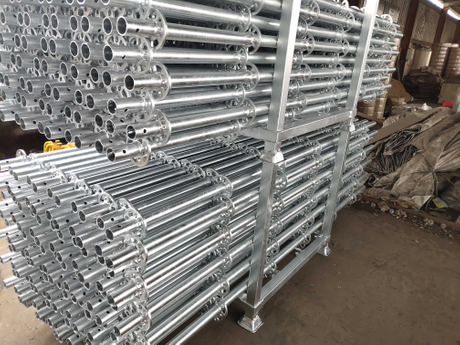
Ringlock is hot-dip galvanized, with strong durability, low wear, and long service life (10–15 years).
Less damaged parts, lower replacement cost over years.
Tube & coupler has more small parts (couplers) that are easy to lose or damage.
Ringlock components are standardized and stack neatly, saving storage and shipping space.
Higher utilization per container than scattered tube & coupler.

If you pursue lowest upfront cost for simple small projects: frame scaffolding is acceptable.
If you need balance of cost and performance: cuplock is a traditional choice.
For large-scale, high-rise, bridge, long-term rental fleets, or high-safety projects:
Ringlock scaffolding has the best cost-performance ratio.
Although the initial investment is slightly higher, it saves a lot on labor, time, maintenance, and replacement costs during use, making it the most economical choice in the long run.