Japanese Type
UTM
UTM-JBC-027
| weight: | |
|---|---|
| Availability: | |
| Quantity: | |
Beam Clamp/Girder Coupler/Gravlock Coupler Japanese Type
The Japanese Type Scaffolding Swivel Beam Clamp is a specialized rotary connecting fitting designed for the Japanese-style scaffolding system. It is used to flexibly fasten scaffolding tubes to steel beams, I-beams, or structural girders. Its core advantage lies in the 360° rotatable central joint, which allows arbitrary angle adjustment between the scaffolding tube and the beam, adapting to complex installation environments in Japanese architectural and industrial projects. It is a key component for ensuring the stability and safety of temporary support structures.
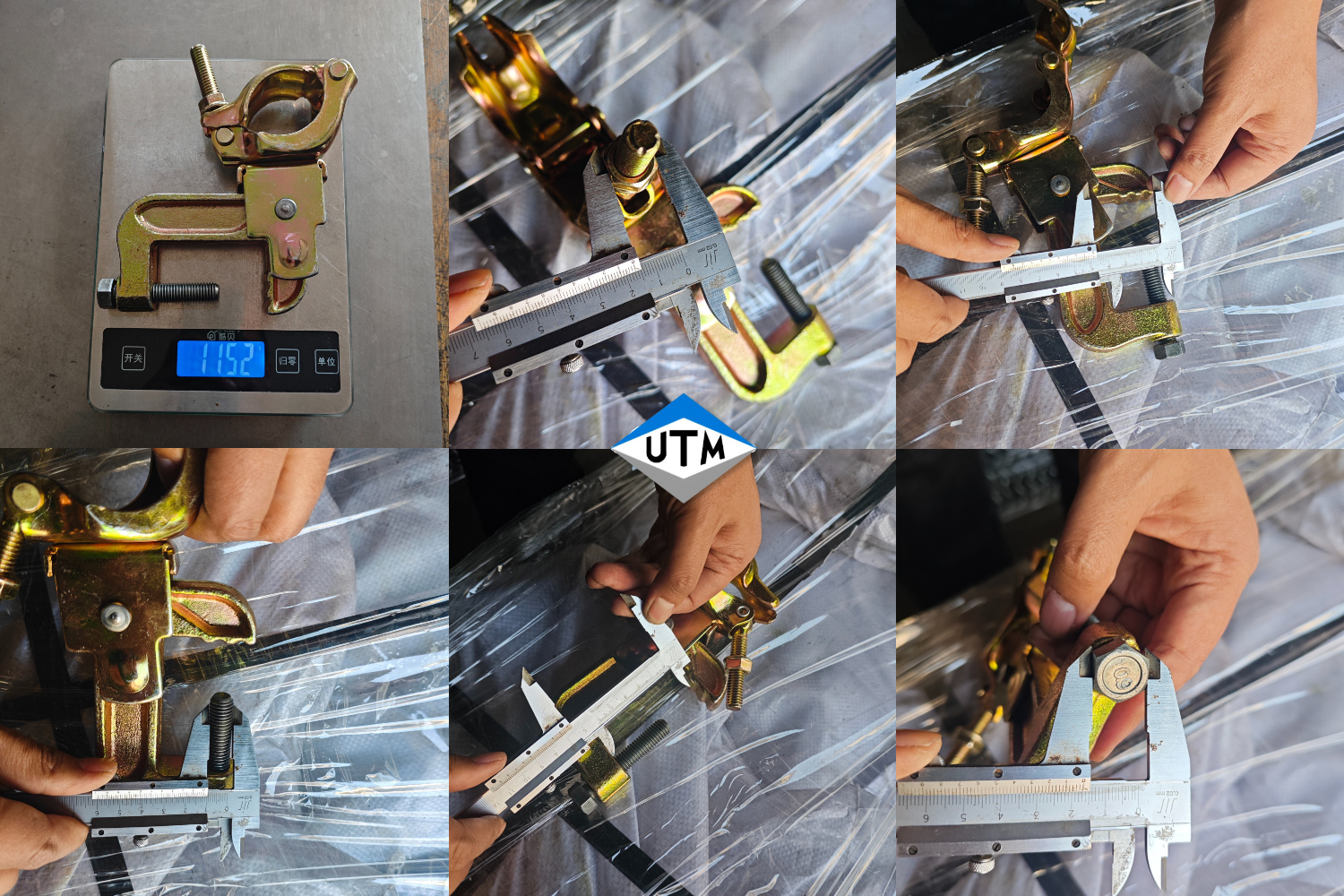
Main Structure: Compact C-type clamping body (optimized for Japanese standard steel beam flanges), with a lightweight yet high-strength design
Material: Japanese standard S45C forged steel or high-grade carbon steel, undergoing quenching and tempering treatment to enhance toughness and load-bearing capacity
Surface Treatment: Electro-galvanized (compliant with JIS G 3313 standard) or powder coating, achieving excellent corrosion resistance for long-term use in humid or outdoor environments
Rotary Mechanism: Precision-machined swivel joint with anti-seize coating, enabling smooth rotation without jamming and maintaining stability after angle locking
Key Components: High-precision threaded bolts (JIS 8.8 grade), lock nuts with anti-loosening washers, and non-slip rubber pads (to prevent scratches on steel beam surfaces and enhance friction)
| Parameter | Specification |
|---|---|
| Applicable Scaffolding Tube Diameter | 48.6mm (Japanese standard) / 48.3mm (international standard, compatible) |
| Maximum Steel Beam Flange Width | 50mm |
| Maximum Flange Thickness | 16-65mm |
| Rated Load-Bearing Capacity | 500-700kg per pair (varies by model) |
| Single Unit Weight | 1.2-1.8kg (lightweight design for easy handling) |
| Compliant Standards | JIS A 4420 (Japanese scaffolding standard), BS EN 74, AS 1576.1 |
Superior Rotational Flexibility: 360° free rotation + 180° tilt adjustment, perfectly adapting to non-right-angle installation scenarios (e.g., curved steel beams, inclined structures)
Compact & Lightweight: Optimized structural design reduces weight by 15-20% compared to European/American counterparts, facilitating high-altitude operation and reducing labor intensity
Precision Fit: Tailored to Japanese standard steel beams and scaffolding tubes, with tight clamping force and no slack during use
Durable & Wear-Resistant: Forged steel body + precision machining, ensuring long service life and reusability (≥50 construction cycles)
Safety Locking Design: Double anti-loosening structure (lock nut + anti-slip washer) prevents bolt loosening due to vibration, complying with strict Japanese safety regulations
Easy Installation: No special tools required; one-person operation can complete clamping and angle adjustment in 30 seconds
Japanese Architectural Construction:
Wooden structure renovation (traditional Japanese houses, temples)
High-rise residential buildings (compatible with Japanese steel frame structures)
Commercial facilities (shopping malls, office buildings) with complex beam structures
Industrial Projects in Japan:
Automobile factories (Toyota, Honda) equipment maintenance platforms
Shipyards (Nissan Motor Ferry, Mitsubishi Heavy Industries) hull construction support
Electrical power facilities (thermal power plants, nuclear power plants) high-altitude operation frames
Overseas Japanese-style Projects:
Japanese-funded construction projects (Southeast Asia, Europe, North America)
Renovation of Japanese-owned commercial buildings and industrial facilities
Infrastructure projects requiring compliance with Japanese safety standards
Mandatory Pair Use: Symmetrically install one clamp on each side of the steel beam flange to ensure balanced force distribution
Installation Steps:
Open the C-type clamp and snap it onto the steel beam flange (ensure the anti-slip pad is in full contact with the flange surface)
Insert the scaffolding tube into the clamp's tube sleeve, adjust to the required angle, and lock the rotary joint
Tighten the bolt to the specified torque (45-55Nm) using a torque wrench
Conduct a pull test to confirm no looseness before use
Safety Precautions:
Do not use for load-bearing beyond the rated capacity
Regularly inspect the rotary joint and bolts for wear; replace immediately if deformation or damage is found
Avoid use in extreme high-temperature (≥200℃) or corrosive (acid/alkali) environments
Must be operated by trained personnel familiar with Japanese scaffolding installation specifications
The Japanese Type Scaffolding Swivel Beam Clamp is a high-performance, precision-engineered fitting tailored to the Japanese scaffolding system and international compatibility needs. Its compact design, flexible rotation, and strict safety compliance make it the preferred choice for Japanese domestic construction, industrial maintenance, and overseas Japanese-funded projects. It not only meets the rigorous requirements of Japanese safety standards but also adapts to global construction scenarios, providing reliable connection solutions for scaffolding systems.

Beam Clamp/Girder Coupler/Gravlock Coupler Japanese Type
The Japanese Type Scaffolding Swivel Beam Clamp is a specialized rotary connecting fitting designed for the Japanese-style scaffolding system. It is used to flexibly fasten scaffolding tubes to steel beams, I-beams, or structural girders. Its core advantage lies in the 360° rotatable central joint, which allows arbitrary angle adjustment between the scaffolding tube and the beam, adapting to complex installation environments in Japanese architectural and industrial projects. It is a key component for ensuring the stability and safety of temporary support structures.

Main Structure: Compact C-type clamping body (optimized for Japanese standard steel beam flanges), with a lightweight yet high-strength design
Material: Japanese standard S45C forged steel or high-grade carbon steel, undergoing quenching and tempering treatment to enhance toughness and load-bearing capacity
Surface Treatment: Electro-galvanized (compliant with JIS G 3313 standard) or powder coating, achieving excellent corrosion resistance for long-term use in humid or outdoor environments
Rotary Mechanism: Precision-machined swivel joint with anti-seize coating, enabling smooth rotation without jamming and maintaining stability after angle locking
Key Components: High-precision threaded bolts (JIS 8.8 grade), lock nuts with anti-loosening washers, and non-slip rubber pads (to prevent scratches on steel beam surfaces and enhance friction)
| Parameter | Specification |
|---|---|
| Applicable Scaffolding Tube Diameter | 48.6mm (Japanese standard) / 48.3mm (international standard, compatible) |
| Maximum Steel Beam Flange Width | 50mm |
| Maximum Flange Thickness | 16-65mm |
| Rated Load-Bearing Capacity | 500-700kg per pair (varies by model) |
| Single Unit Weight | 1.2-1.8kg (lightweight design for easy handling) |
| Compliant Standards | JIS A 4420 (Japanese scaffolding standard), BS EN 74, AS 1576.1 |
Superior Rotational Flexibility: 360° free rotation + 180° tilt adjustment, perfectly adapting to non-right-angle installation scenarios (e.g., curved steel beams, inclined structures)
Compact & Lightweight: Optimized structural design reduces weight by 15-20% compared to European/American counterparts, facilitating high-altitude operation and reducing labor intensity
Precision Fit: Tailored to Japanese standard steel beams and scaffolding tubes, with tight clamping force and no slack during use
Durable & Wear-Resistant: Forged steel body + precision machining, ensuring long service life and reusability (≥50 construction cycles)
Safety Locking Design: Double anti-loosening structure (lock nut + anti-slip washer) prevents bolt loosening due to vibration, complying with strict Japanese safety regulations
Easy Installation: No special tools required; one-person operation can complete clamping and angle adjustment in 30 seconds
Japanese Architectural Construction:
Wooden structure renovation (traditional Japanese houses, temples)
High-rise residential buildings (compatible with Japanese steel frame structures)
Commercial facilities (shopping malls, office buildings) with complex beam structures
Industrial Projects in Japan:
Automobile factories (Toyota, Honda) equipment maintenance platforms
Shipyards (Nissan Motor Ferry, Mitsubishi Heavy Industries) hull construction support
Electrical power facilities (thermal power plants, nuclear power plants) high-altitude operation frames
Overseas Japanese-style Projects:
Japanese-funded construction projects (Southeast Asia, Europe, North America)
Renovation of Japanese-owned commercial buildings and industrial facilities
Infrastructure projects requiring compliance with Japanese safety standards
Mandatory Pair Use: Symmetrically install one clamp on each side of the steel beam flange to ensure balanced force distribution
Installation Steps:
Open the C-type clamp and snap it onto the steel beam flange (ensure the anti-slip pad is in full contact with the flange surface)
Insert the scaffolding tube into the clamp's tube sleeve, adjust to the required angle, and lock the rotary joint
Tighten the bolt to the specified torque (45-55Nm) using a torque wrench
Conduct a pull test to confirm no looseness before use
Safety Precautions:
Do not use for load-bearing beyond the rated capacity
Regularly inspect the rotary joint and bolts for wear; replace immediately if deformation or damage is found
Avoid use in extreme high-temperature (≥200℃) or corrosive (acid/alkali) environments
Must be operated by trained personnel familiar with Japanese scaffolding installation specifications
The Japanese Type Scaffolding Swivel Beam Clamp is a high-performance, precision-engineered fitting tailored to the Japanese scaffolding system and international compatibility needs. Its compact design, flexible rotation, and strict safety compliance make it the preferred choice for Japanese domestic construction, industrial maintenance, and overseas Japanese-funded projects. It not only meets the rigorous requirements of Japanese safety standards but also adapts to global construction scenarios, providing reliable connection solutions for scaffolding systems.