- All
- Product Name
- Product Keyword
- Product Model
- Product Summary
- Product Description
- Multi Field Search
Views: 0 Author: Site Editor Publish Time: 2026-07-17 Origin: Site


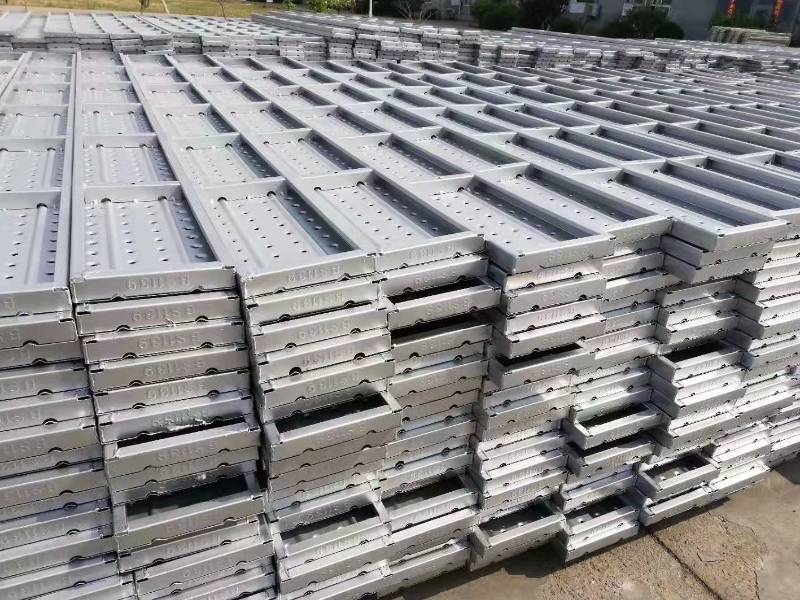
A steel scaffolding board is a metal plank that is used as a walking surface or working platform within a scaffolding system. These boards offer a safe, steady platform to stand, walk and position tools and materials when working at height.
Steel scaffolding planks are generally made of high-strength structural steel, such as Q195, Q235 or S235 grades, and are often hot-dip galvanized or pre-galvanized to prevent rust and corrosion. They are designed to be temporary, reusable and compatible with a wide range of scaffolding systems such as ringlock, cuplock, frame and tube-and-coupler scaffolds.
Steel scaffolding boards can support significant weight, making them suitable for heavy-duty construction applications. Load classes range from Class 1 to Class 6 under EN 12811 standards, with Class 6 supporting up to 6.00 kN/m². Some heavy-duty steel planks can withstand loads exceeding 4,500 kg/m².
Unlike timber boards, steel does not combust, significantly enhancing worksite safety — particularly in environments where welding, cutting, or other hot work is performed.
With hot-dip galvanized or pre-galvanized surface treatments, steel scaffolding boards resist moisture, corrosion, and extreme temperatures. Hot-dip galvanizing provides the highest level of corrosion protection, with a service life exceeding 5 to 10 years even in harsh environments.
Most steel scaffold boards have perforated, embossed or punched-hole surfaces that provide excellent slip resistance in both dry and wet conditions. On some of the premium boards the slip resistance is R13 (slope >35°) to DIN 51130 and the average PTV (Pendulum Test Value) is 73 dry and 51 wet to BS 7976.
Steel is highly durable and can be reused across multiple projects, reducing long-term costs despite a higher initial investment compared to wood.
Steel is 100% recyclable, making steel scaffolding boards an environmentally friendly choice that reduces waste and the need for frequent replacements.
Despite being steel, many modern steel scaffolding boards are engineered to be lightweight. For example, a 3.9-meter PcP steel board weighs less than 20 kg — lighter than a wet timber board of equivalent length.
Parameter | Common Specifications |
|---|---|
Material | Q195, Q235, Q345 steel |
Surface Treatment | Pre-galvanized, Hot-dip galvanized (HDG), Black, Powder-coated |
Thickness | 1.1 mm – 2.0 mm (customizable) |
Width | 210 mm, 225 mm, 230 mm, 240 mm, 250 mm, 300 mm, 320 mm, 450 mm, 500 mm |
Length | 1.0 m – 4.0 m (custom sizes available) |
Weight | Varies by size; e.g., 240×45×1.2mm × 2000mm ≈ 7.35 kg |
Surface Type | Perforated, embossed, plain |
Load Capacity | 150 kg – 250 kg per board (standard); heavy-duty up to 500+ kg |
Standards | EN 12811-1, BS 1139, EN 1004, AS 1577 |
Certifications | CE, ISO, SGS, BV, TUV |
Immersed in molten zinc at over 800°F, this process creates a thick, metallurgically bonded zinc coating that offers superior corrosion resistance. Ideal for outdoor, coastal, and harsh environments.
Galvanized before fabrication, these boards offer a cost-effective alternative with good corrosion protection, suitable for indoor or moderate outdoor use.
An additional protective layer enhances durability and aesthetic appeal, available in various colors.
Designed with punched holes or slots, perforated boards improve drainage, reduce weight (by up to 20%), and provide anti-slip grip.
Steel scaffolding boards are designed to integrate seamlessly with various scaffolding systems:
Ringlock Scaffolding — boards with hooks, typically 228 mm or 240 mm width
Cuplock Scaffolding
Frame Scaffolding
Tube and Coupler Scaffolding — boards without hooks, secured with board retaining couplers
Kwikstage Scaffolding
Layher Allround Scaffolding